Notice: Function _load_textdomain_just_in_time was called incorrectly. Translation loading for the redux-framework domain was triggered too early. This is usually an indicator for some code in the plugin or theme running too early. Translations should be loaded at the init action or later. Please see Debugging in WordPress for more information. (This message was added in version 6.7.0.) in /var/www/blog.planmysocial.ai/wp-includes/functions.php on line 6260

Notice: Function _load_textdomain_just_in_time was called incorrectly. Translation loading for the all-in-one-seo-pack domain was triggered too early. This is usually an indicator for some code in the plugin or theme running too early. Translations should be loaded at the init action or later. Please see Debugging in WordPress for more information. (This message was added in version 6.7.0.) in /var/www/blog.planmysocial.ai/wp-includes/functions.php on line 6260

Notice: Function _load_textdomain_just_in_time was called incorrectly. Translation loading for the insert-headers-and-footers domain was triggered too early. This is usually an indicator for some code in the plugin or theme running too early. Translations should be loaded at the init action or later. Please see Debugging in WordPress for more information. (This message was added in version 6.7.0.) in /var/www/blog.planmysocial.ai/wp-includes/functions.php on line 6260

Notice: Function _load_textdomain_just_in_time was called incorrectly. Translation loading for the wpforms-lite domain was triggered too early. This is usually an indicator for some code in the plugin or theme running too early. Translations should be loaded at the init action or later. Please see Debugging in WordPress for more information. (This message was added in version 6.7.0.) in /var/www/blog.planmysocial.ai/wp-includes/functions.php on line 6260

Notice: Function _load_textdomain_just_in_time was called incorrectly. Translation loading for the gutenverse domain was triggered too early. This is usually an indicator for some code in the plugin or theme running too early. Translations should be loaded at the init action or later. Please see Debugging in WordPress for more information. (This message was added in version 6.7.0.) in /var/www/blog.planmysocial.ai/wp-includes/functions.php on line 6260

Notice: Function _load_textdomain_just_in_time was called incorrectly. Translation loading for the redux-framework domain was triggered too early. This is usually an indicator for some code in the plugin or theme running too early. Translations should be loaded at the init action or later. Please see Debugging in WordPress for more information. (This message was added in version 6.7.0.) in /var/www/blog.planmysocial.ai/wp-includes/functions.php on line 6260

Notice: Function _load_textdomain_just_in_time was called incorrectly. Translation loading for the redux-framework domain was triggered too early. This is usually an indicator for some code in the plugin or theme running too early. Translations should be loaded at the init action or later. Please see Debugging in WordPress for more information. (This message was added in version 6.7.0.) in /var/www/blog.planmysocial.ai/wp-includes/functions.php on line 6260

Warning: Cannot modify header information - headers already sent by (output started at /var/www/blog.planmysocial.ai/wp-includes/functions.php:6260) in /var/www/blog.planmysocial.ai/wp-content/plugins/all-in-one-seo-pack/app/Common/Meta/Robots.php on line 87

Warning: Cannot modify header information - headers already sent by (output started at /var/www/blog.planmysocial.ai/wp-includes/functions.php:6260) in /var/www/blog.planmysocial.ai/wp-includes/feed-rss2.php on line 8
Social Media Marketing - Plan My Social https://blog.planmysocial.ai Wed, 08 May 2024 08:14:33 +0000 en-US hourly 1 https://wordpress.org/?v=7.1.2 https://blog.planmysocial.ai/wp-content/uploads/2024/04/cropped-1200x1200-1-32x32.jpg Social Media Marketing - Plan My Social https://blog.planmysocial.ai 32 32 25 Social Media Platforms Ranked for Brands in 2024 https://blog.planmysocial.ai/social-media-platforms/?utm_source=rss&utm_medium=rss&utm_campaign=social-media-platforms Wed, 08 May 2024 06:49:25 +0000 https://blog.planmysocial.ai/?p=10858 Social media platforms are online applications and tools for sharing visual content in the form of images, videos, and text.    In today’s digital age, social media has become an indispensable tool for businesses of all sizes. Understanding the most widely used social media platforms is beneficial for anyone interested in utilizing social media, be …

The post 25 Social Media Platforms Ranked for Brands in 2024 first appeared on Plan My Social.

]]>

Social Media Marketing

25 top social media platforms for brands

Social media platforms are online applications and tools for sharing visual content in the form of images, videos, and text. 


In today’s digital age, social media has become an indispensable tool for businesses of all sizes. Understanding the most widely used social media platforms is beneficial for anyone interested in utilizing social media, be they an experienced marketer, someone just starting out in the field, or a business owner hoping to take advantage of social media’s huge potential.


4.8 billion people use social media globally, accounting for 92.7% of all internet users and 59.9% of the world’s population.


It provides a powerful platform to connect with your target audience, build brand awareness, and achieve your marketing goals. 


But with so many social media platforms available, deciding which ones to focus on and how to leverage them effectively can be overwhelming.

Top 10 Social Media Platforms

S.NoPlatforms

Monthly Active Users (MAUs)

Revenue

Headquarters 

Launched

1

Facebook

3,530 million 

$120.18 billion

Menlo Park, CA

2004

2

Instagram

2,000 million

$49.91 billion

Menlo Park, CA

2010

3

WhatsApp

2,000 million

$1248 billion

Menlo Park, CA

2009

4

YouTube

2,491 million

$29.24 billion

San Bruno, California

2005

5

Tik Tok

1,218 million

$14.7 billion

Culver City, CA

2016

6

X (Twitter)

666 million

$4.4 billion

Mountain View, CA

2003

7

LinkedIn

370 million

$15. 4 billion

San Francisco, CA

2006

8

Pinterest

465 million

$2.8 billion

San Francisco, CA

2005

9

Threads

100 million

$4.6 billion

Menlo Park, CA

2023

10

Snapchat

750 million

$4.60 billion

Los Angeles, CA

2011

25 Social media platforms your brand must leverage in 2024

We’ve compiled a list of some of the most popular social media apps and websites worldwide, arranged in no specific order, to assist your business in developing its social media strategy.

1. Facebook


Founders: Mark Zuckerberg, Eduardo Saverin, Dustin Moskovitz, and Chris Hughes


Facebook remains the social media king, boasting the largest and most diverse user base globally, with over 3.05 billion monthly active users as of April 2024.


It allows users to connect with friends and family, share posts, photos, videos, stories, and join groups with similar interests.


Think about utilizing Messenger chatbots for individualized communication, creating or joining specialized groups on Facebook Groups, or utilizing live video to promote audience engagement in real time.


How businesses can use the platform: 


Build a strong Facebook Page to be a hub for your brand. 

Share informative and engaging content that resonates with your target audience. 

Utilize Facebook Groups to foster a community around your brand and interests. 

Facebook Ads Manager allows for highly targeted advertising campaigns to reach new customers. 

Remember, Facebook thrives on interaction, so respond to comments and messages promptly to build relationships with your audience.

2. Instagram


Founders: Kevin Systrom, Mike Krieger

I

nstagram is a visually-driven social media platform with over 2.04 billion monthly active users. 


It’s a fantastic platform for businesses that can showcase their products or services aesthetically. High-quality photos and videos are key to grabbing attention. 


The potential return on investment (ROI) for product-based businesses has increased since the introduction of shoppable posts in 2018.


B2B companies can use Instagram’s UI to interact with a large audience as well as easily move followers from product research to purchase by connecting product details and completing purchases.


Additionally, with over 68% of Instagram users under 35, the platform is a goldmine if that’s your target market.


Stories and Reels offer additional features for businesses to share behind-the-scenes glimpses, product tutorials or even host live Q&A sessions.


How businesses can use the platform: 


Create a visually appealing Instagram Business Profile. 

Utilize high-quality photos and videos to showcase your products or services. 

Leverage Instagram Stories and Reels to create engaging content that disappears after 24 hours. 

Partner with Instagram influencers who resonate with your brand to reach a wider audience and leverage their credibility. 

Remember, Instagram thrives on community engagement, so run contests, reply to comments, and participate in relevant hashtags.

3. WhatsApp


Founders: Jan Koum, Brian Acton

More than just a messaging app, WhatsApp is a powerful customer communication tool with over 2.78 billion monthly active users globally.


It allows users to send text messages, voice notes, photos, videos, and even share their location. Businesses can leverage the WhatsApp Business App or WhatsApp Business API, depending on their needs.


How businesses can use the platform: 


Direct Communication: Respond to customer inquiries with a 70% open rate due to the familiarity of the platform, offer personalized support, and send appointment reminders. 


Marketing & Sales: Share product catalogs, send promotional updates, offer limited-time deals, and even allow customers to browse products directly in WhatsApp. 


Increased Engagement: Run contests and giveaways to spark excitement and boost engagement. 

Remember, WhatsApp prioritizes personal interaction, so maintain a friendly and approachable tone in your communication.

4. YouTube


Founders:  Chad Hurley, Steve Chen, and Jawed Karim


YouTube is the world’s leading video platform, with over 2.49 billion monthly active users.


It allows users to watch, share, and upload videos of all kinds. It’s a powerful tool for businesses to create brand awareness, educate customers, and showcase their expertise.


To create interesting YouTube videos from your blog entries, use the AI Video Marketing Automator. It’s a quick and simple method of adding relevant data to your channel.


Additionally, the business claims that it’s an extremely effective marketing tool. Compared to other social networks, YouTube viewers indicate they are 4X more likely to utilize the platform to find information about a company, product, or service and 2X more likely to purchase something they saw on the platform.


How businesses can use the platform:


Create a YouTube channel to share explainer videos, product demonstrations, customer testimonials, and brand stories. 

Utilize YouTube Ads to target your ideal audience based on demographics and interests. 

Learn about YouTube SEO (Search Engine Optimization) to improve your video ranking and organic reach. 

Run contests and giveaways to encourage viewers to subscribe and engage with your channel.

5. Tiktok


Founders: Zhang Yiming (ByteDance)


Known for its short-form, viral video trends, dances, challenges, and creative content, TikTok boasts over 1.22 billion monthly active users, particularly popular with a younger demographic.


TikTok has been downloaded over 3.5 billion times worldwide as of 2021, despite attempts to outlaw the program in the United States and India.


Even if TikTok caters to a wide range of customers, connecting with Generation Z should be your first focus as a brand.


While seemingly lighthearted, TikTok offers a unique platform for businesses to showcase their brand personality in an authentic and engaging way, reaching a demographic that might be difficult to connect with elsewhere.


How businesses can use the platform: 


Create fun, short videos that creatively showcase your products or services.

Collaborate with relevant TikTok creators, known as TikTokers, to reach a wider audience and leverage their established fanbase. Partnering with the right influencer can significantly boost brand awareness. 

Create branded hashtag challenges to encourage user-generated content and boost brand awareness. User-generated content can be a powerful marketing tool, as it builds trust and authenticity with potential customers. 

Behind-the-Scenes Glimpses: Offer viewers a peek into your company culture or the production process to build a deeper connection. Transparency and authenticity are valued on TikTok, so don’t be afraid to show the human side of your brand. 

Remember, TikTok thrives on authenticity and entertainment value, so keep your content fun, fast-paced, and visually engaging. By understanding these core aspects of each platform and tailoring your approach accordingly, you can harness the power of social media to connect with your target audience, build brand awareness, and ultimately achieve your business goals.

6. X (formerly known as Twitter):


Founders: Jack Dorsey, Noah Glass, Biz Stone, and Evan Williams


Twitter is a microblogging platform where users can post and share messages (limited to 280 characters) called “tweets.” It fosters real-time conversations and news updates through hashtags and trending topics. 


With over 436 million monthly active users as of April 2024, Twitter offers a fast-paced and dynamic environment for brands to engage with their audience.


During his tenure as CEO, Musk also shut down several bot accounts, introduced Twitter Blue (now X Premium), a paid monthly subscription service that attached a price tag to verification, and launched a service that pays creators a percentage of the money their subscribers generate.


This could account for the variations in the statistics and data on X’s user base and traffic. Although some reports indicate that X’s traffic is declining year over year, Musk stated in a July tweet that the number of monthly users hit an all-time high in 2023.


Brands have a chance to refine and build their voice on X. It’s possible to be both witty and approachable and still be useful and educational.


Focus: Breaking news, current events, public discourse, and thought leadership.


How businesses can use the platform: 


Twitter offers a platform for brands to:

Share real-time updates and announcements (product launches, news, events).

Engage in conversations with customers and industry influencers (respond to mentions, participate in relevant discussions).

Utilize targeted advertising to reach a specific audience based on demographics and interests.

Provide customer support through direct messages (answer questions, address concerns).

Twitter is a great platform to stay connected to your audience in real-time. Share valuable content, engage in conversations, and leverage targeted advertising to build brand awareness.
7. LinkedIn


Founders: Reid Hoffman, Allen Blue, Konstantin Guericke, Eric Lee, and Jean-Luc Vaillant


LinkedIn does not disclose its monthly active user count to the public, in contrast to other social media sites. The team at Social Media Today was able to arrive at “less than 350 million” as a reasonable estimate by taking the percentage of active users in the EU, applying the same trends to global user counts, and accounting for variations in usage. Nevertheless, the company did release MAU counts for its EU users as part of the EU’s new DSA.


LinkedIn is the world’s largest professional networking platform, boasting over 830 million members as of April 2024. Users connect with colleagues, showcase their professional experience, and discover job opportunities.


With more than 180 million members in senior jobs, 63 million decision-makers, and 10 million C-level executives, the platform is a popular place to meet people who can collaborate with your brand, hire your company, or stock your goods.


The site serves as an aspirational hub in addition to being a place for networking. With 61 million users searching for jobs on LinkedIn each week, it’s a wise location to promote your business.


How businesses can use the platform: 


Build a company profile and showcase company culture (mission, values, team).

Post job openings and attract qualified candidates with relevant skills and experience.

Share industry insights and thought leadership content (articles, reports, videos).

Network with potential business partners and clients (connect with industry leaders, attend online events).

Establish your brand as a thought leader! LinkedIn is a prime platform to connect with professionals in your industry, showcase your expertise, and attract top talent.

8. Pinterest


Founders: Ben Silbermann, Evan Sharp, Paul Sciarra


Think of Pinterest as a visual search engine that meets mood boards. Users curate collections (“boards”) with inspiring images and videos, from delicious recipes to dream vacation destinations. 


It’s a treasure trove of inspiration for users and a goldmine for brands with visually compelling products.  80% of Pinners use the platform to discover new products.


Remarkably, women make up 60% of Pinterest users. It makes sense to devote time on Pinterest social media marketing if the majority of your audience is female.


That’s not to suggest that males don’t use Pinterest; in fact, male and Gen Z pinnerships have increased by 40% in the past year.


Additionally, Pinterest has shown to be an effective marketing tool. 80% of weekly Pinners have found a new product or brand on Pinterest, and eighty percent of Pinners use the platform as inspiration before making a purchase.


How businesses can use the platform: 


Don’t just throw random products on Pinterest. Showcase them in a way that ignites users’ imaginations. 

Create boards around themes relevant to your audience and use high-quality visuals. 

Run targeted ads to reach people actively searching for inspiration related to your niche.  

Think of it as a way to get in front of potential customers who are already looking for exactly what you offer, but with a creative twist.
9. Threads


Founders: Meta Platforms (parent company of Facebook, Instagram)


Threads is the new kid on the block, aiming to carve out a space for more intimate social interactions. Unlike the sprawling openness of Facebook, Threads focuses on close friends, allowing you to share quick updates, photos, and videos throughout the day. 


Think of it as a digital group chat with a visual twist, perfect for staying connected with your closest circles.


How businesses can use the platform:


While Threads is still finding its footing, here are some creative ways brands can potentially leverage it. 

Host exclusive AMAs (Ask Me Anything) or behind-the-scenes content for your most loyal followers, fostering a sense of community and exclusivity. 

Partner with relevant micro-influencers who have established connections with smaller, more engaged audiences.  

Threads allows for a more personal and conversational approach, where brands can feel less like a corporation and more like a friend in the loop.

10. Snapchat


Founders: Evan Spiegel, Bobby Murphy, Reggie Brown


If Facebook is the yearbook of social media, Snapchat is the crazy house party. It’s known for its disappearing messages (Snaps) – photos and videos that vanish after a set time. 


Snapchat is a paradise for user-generated content, behind-the-scenes films, exclusive deals, and influencer takeovers because of its distinctively organic vibe and content that provides an unedited look into ordinary situations.


The site provides users with a sense of anonymity that many other social media platforms do not, and it has always upheld its dedication to real-time, transient information. Because of this, it’s a valuable tool for marketers looking to connect with a younger audience who might not be as interested in the more expansive strategies of other social networks.


This ephemeral nature fosters a sense of urgency and real-time connection, making it perfect for behind-the-scenes glimpses, playful promotions, and fun, interactive experiences with Augmented Reality (AR) filters and lenses.


How businesses can use the platform: 


Forget stuffy press releases. Run interactive ad campaigns with fun filters and lenses that people will actually enjoy using. 

Offer exclusive discounts or sneak peeks at upcoming products through eye-catching Snapchat stories. 

Partner with influencers to create engaging Snaps that showcase your brand in a way that feels authentic and relatable.

11. WeChat


Founders: Zhang Xiaolong (Allen Zhang)

Imagine an app that combines messaging, social media, and mobile payments – that’s WeChat in a nutshell. It’s a giant in China, allowing users to chat, share photos and videos, hail rides, and even pay bills – all within one platform.  


For businesses looking to reach the Chinese market, WeChat offers a unique opportunity to connect with users on a deeper level.


How businesses can use the platform: 


Create a WeChat Official Account to connect with potential customers. 

Share informative content, run targeted ads, and leverage WeChat Pay to facilitate seamless in-app purchases.

12. Telegram


Founders: Nikolai Durov, Pavel Durov


Think of Telegram as a messaging app on steroids. It offers robust encryption, large file sharing capabilities, and group chats that can accommodate thousands of users. 


This focus on privacy and large groups makes Telegram popular with specific communities and niche audiences.


How businesses can use the platform: 


Create a Telegram channel to share updates, announcements, or exclusive content for your most engaged followers.  

Telegram works well for closed groups where you can foster discussions and build a strong community around your brand.

13. Quora


Founders: Adam D’Angelo, Charlie Cheever


Quora is the land of questions and answers. It’s a platform where users can ask questions on any topic imaginable and get answers from experts and everyday people. Businesses can leverage this platform to establish themselves as thought leaders in their industry.


How businesses can use the platform: 


Actively participate in industry-related questions. 

Provide insightful and helpful answers that showcase your expertise. 

This not-so-subtle brand awareness can position you as a trusted source and potentially lead curious users to your website or social media channels.

14. Kuaishou


Founders: Su Hua (宿华) 程一笑 (Cheng Yixiao)


Kuaishou, meaning “fast hand” in Chinese, is a video-sharing platform known for its short-form videos and live streaming.  


The corporation, “GIF Kuaishou,” was founded in 2011. Making GIFs was the platform’s main function at the time. Kuaishou debuted short videos in 2013. They incorporated live streaming in 2016. 


These days, it’s beginning to spread to other industries, such as mobile gaming and e-commerce. In the e-commerce sector, Kuaishou became well-known for its “shopping festivals.


Similar to TikTok, it thrives on user-generated content, funny edits, and quick bursts of entertainment. For businesses looking to tap into the Chinese market, particularly younger demographics, Kuaishou offers a dynamic platform for creative brand storytelling.


How businesses can use the platform: 


Partner with Kuaishou influencers to create engaging video content that resonates with the platform’s audience. 

Run targeted ad campaigns with eye-catching visuals and music to grab attention. 

Experiment with live streaming events to showcase products or interact with potential customers in real-time.
15. Weibo


Founders: Wang Xing (王兴)


Often referred to as “Chinese Twitter,” Weibo is a microblogging platform where users share short updates, photos, and videos.  


Weibo presents commercial opportunities as well. Influencer marketing, sponsored posts, and the “Weibo lottery,” in which followers can win rewards from companies, are all effective ways for businesses to expand and increase brand awareness.


It’s a hotbed for discussions, news sharing, and celebrity gossip. Brands can leverage Weibo to engage in real-time conversations, promote trending topics or hashtags, and build brand awareness through targeted advertising.


How businesses can use the platform: 


Create engaging content that sparks conversation and encourages users to share and comment.  

Run contests or giveaways to generate excitement and increase brand visibility.  

Partner with Weibo influencers to promote your brand to their established audience.

16. QQ


Founders: Ma Huateng (马化腾)


QQ is a messaging giant in China, offering instant messaging, online games, and social networking features. 


Think of it as a combination of Facebook Messenger and a lite social media platform.  Businesses can leverage QQ to connect with customers on a more personal level and provide customer support through the platform’s chat functionality.


How businesses can use the platform: 


Create a dedicated QQ group for your brand to foster communication and build a community.  

Offer customer service through QQ chat to address inquiries and build trust with potential customers.  

Run targeted ads within the QQ platform to reach users based on demographics and interests.
17. Qzone


Founders: Ma Huateng (马化腾)


Qzone, literally “QQ zone,” is a social networking site integrated with QQ messenger. Users can share photos, videos, and blogs like Facebook profiles.  


While not as widely used as QQ messenger itself, Qzone offers a space for businesses to showcase their brand personality and connect with users on a more personal level.


How businesses can use the platform: 


Create a Qzone page to share visually engaging content that resonates with your target audience.  

Run contests or polls to encourage user interaction and brand awareness.  

Partner with QQ influencers who are also active on Qzone to leverage their reach and credibility.

18. Reddit


Founders: Steve Huffman, Alexis Ohanian, Aaron Swartz


Think of Reddit as a giant online forum with a strong community focus. Users (“Redditors”) can submit content (text posts, links, images, videos) and vote on it, with the most popular content rising to the top.  


Reddit offers a distinctive combination of community and material, with over 2.8 million subreddits, or communities, covering any and all topics. Regardless of your industry—tech, fashion, gaming, or health—at least one subreddit is always engaged in discussions.


Discussions happen in subreddits, dedicated communities focused on specific topics. Brands can leverage Reddit to engage with niche audiences, participate in relevant conversations, and build brand loyalty through authentic interactions.


Every brand and company can engage their audience in one of the many niches available; all you have to do is identify the ones where your target market is active and jump in.


But take note: Reddit is a place where sincerity and real communication are highly valued. Consumers are generally not amenable to overt self-promotion, therefore marketing tricks are likely to be viewed with acute suspicion.


How businesses can use the platform: 


Don’t just spam your products.  

Actively participate in subreddits relevant to your industry by providing helpful and informative comments.  

Run AMA (Ask Me Anything) sessions to connect with potential customers and answer their questions directly.  

Partner with Reddit communities or influencers to create sponsored content that feels organic and relevant to the subreddit.

19. Discord


Founders: Jason Citron, Stanislav Vishnevsky


Originally created for gamers, Discord has evolved into a versatile chat platform with features like voice chat, video calls, and screen sharing. 


Servers (similar to group chats) can be public or private, allowing for focused discussions and fostering a strong sense of community. Brands can leverage Discord to connect with passionate communities, offer customer support, and build brand loyalty through behind-the-scenes access.


How businesses can use the platform: 


Create a branded Discord server to connect with your audience and offer a space for discussions and interaction.   

Host live chats or AMAs with your team members to provide insights and build a personal connection.  

Offer exclusive content or early access to products/services for active members of your Discord server.

But remember that ads are not allowed on Discord. Alternatively, companies can set up a server for their community and interact with users that way.

20. Twitch

Founders: Justin Kan, Emmett Shear


Twitch is the king of live streaming for gamers.  It’s a platform where gamers broadcast their gameplay, interact with viewers in real-time, and create a community around shared interests.  


In Q3 2022, Twitch users watched 5.71 billion hours of content.


While gaming is a major focus, Twitch has expanded to include creative content like art streams and live music performances. Brands can leverage Twitch to reach a highly engaged audience, showcase product integrations in a live setting, and partner with streamers to promote their brand in an authentic way.


How businesses can use the platform: 


Sponsor popular streamers who align with your brand image to reach a relevant audience.  

Run interactive ad campaigns that encourage viewers to participate in live streams.  

Host your own Twitch streams to showcase your products or expertise in a fun and engaging way.

21. Tumblr


Founders: David Karp


Tumblr is a microblogging platform with a focus on short-form content – text posts, images, videos, and audio. Known for its creative and quirky user base, Tumblr allows for self-expression and exploration of diverse interests. 


Brands can leverage Tumblr to target niche audiences, showcase their creative side, and build brand awareness through engaging content.


How businesses can use the platform: 


Create a branded Tumblr page to share visually appealing content that resonates with your target audience.  

Run contests or challenges that encourage user-generated content related to your brand.  

Partner with relevant Tumblr blogs to promote your brand or products to their established audience.

22. Mastodon


Founders:  Eugen Rochko, Christophe Wolinski


If you value privacy and control over your social media experience, Mastodon might be for you. Unlike centralized platforms where a single company controls the rules and user data, Mastodon is a decentralized social network. 


It’s made up of a federation of independently run servers, each with its own focus and community guidelines. This allows users to choose a server that aligns with their values and interests.


How businesses can use the platform: 


Mastodon’s decentralized nature makes it a less traditional space for brand building. 

However, businesses catering to niche communities can find a home here. 

You can create a server focused on your industry and foster discussions, share insights, and build relationships with potential customers who value privacy.

23. Bluesky


Founders: Jack Dorsey, Jay Graber


Instead of being a single platform, Bluesky is an ambitious project aiming to create a protocol for social media. Think of it as a set of rules and standards that different social media apps can choose to adopt. 


This could lead to a more interoperable social media landscape, where users can follow each other and share content across different platforms, even if they’re not owned by the same company.


How businesses can use the platform: 


Since Bluesky is still in development, it’s too early to say definitively how businesses can leverage it. However, the idea of an interoperable future opens doors for wider reach and more control over how your brand interacts with users across the social media spectrum.

24. Viber


Founders: Igor Magazinnik (CEO), Viber Media Inc.


While WhatsApp reigns supreme in many parts of the world, Viber is a messaging app that holds strong popularity in Eastern Europe and some other regions. It offers features like instant messaging, voice and video calls, and group chats, similar to its competitors.


How businesses can use the platform: 


If your target audience is located in a region where Viber is dominant, consider incorporating it into your strategy. 

You can create a community chat or channel to connect with customers, offer customer support, or run targeted promotions within the Viber platform.

25. Imo


Founder: Georges Harik


Similar to Viber, Imo is another messaging app with a strong presence in certain markets, particularly in developing countries and regions like Latin America, the Middle East, and Southeast Asia. It offers features for calls, texts, and video chats.


How businesses can use the platform: 

As with Viber, Imo’s relevance depends on your target audience. If your ideal customer is located in a region where Imo is popular, explore using it for customer service, promotions, or community building through group chats.

Which social media platforms should you use for your brand in 2024?

Picking your brand’s perfect social media platforms depends on what you want to achieve. Here’s a quick guide:

Goals first:

Brand awareness? Go for Facebook, Instagram, or YouTube for broad reach.

Lead generation? Target LinkedIn or Twitter for professionals.

Fan base? Build a community on Discord or Threads.

Know your audience:

Age, interests, social media habits – all this matters!

Pick your platforms:

2-3 core platforms: Be consistent here with quality content.

1-2 extras: Explore platforms where your audience thrives.

Emerging options (optional): Consider new platforms like Mastodon, but prioritize based on resources and audience fit.

Remember: Great content, consistent posting, and data analysis are key.  Focus on quality to grab attention. There’s no one-size-fits-all answer, so be strategic, experiment, and adapt based on your audience and goals.

How can Plan My Social help with social media management?

Plan My Social is a great social media management tool that can help you generate content, plan, schedule, and publish content consistently on all social media platforms. 

You can also generate social media content using their AI-powered features. 

Plan My Social can manage your social media profiles across various platforms, all under a single platform. This includes scheduling posts in advance. 

It provides regular reports with data visualizations and analysis to clearly show your social media performance. Their data-driven approach helps you make informed decisions and adjust your strategy as needed.

By leveraging the expertise of a social media management company like Plan My Social, you can streamline your social media efforts and achieve better results on the platforms that matter most to your brand.

Table of Contents

The post 25 Social Media Platforms Ranked for Brands in 2024 first appeared on Plan My Social.

]]>
How to Create A Social Media Content Calendar – Step by Step  https://blog.planmysocial.ai/social-media-content-calendar/?utm_source=rss&utm_medium=rss&utm_campaign=social-media-content-calendar Sat, 04 May 2024 10:59:08 +0000 https://blog.planmysocial.ai/?p=10772 In today’s digital age, social media is a powerful tool for businesses to connect with their audience, boost brand awareness, and ultimately drive business growth. However, simply having accounts on various platforms is required. To truly harness this potential, you need a strategic and organized approach – enter the social media content calendar.   This …

The post How to Create A Social Media Content Calendar – Step by Step  first appeared on Plan My Social.

]]>
Social Media Marketing

In today’s digital age, social media is a powerful tool for businesses to connect with their audience, boost brand awareness, and ultimately drive business growth. However, simply having accounts on various platforms is required. To truly harness this potential, you need a strategic and organized approach – enter the social media content calendar.


This guide will walk you through the process of creating a content calendar, step-by-step, empowering you to take control of your brand’s social media. By following these steps you’ll be well on your way to a thriving online presence.


Let’s get started.

What is a social media content calendar?

A social media calendar is a comprehensive and well-planned schedule of forthcoming posts for all your social media platforms. It is organized according to their publish date and time. Your social media calendar can include links, tags, @mentions, prose, and media, including videos and pictures, in addition to the publish date and time for posts.


A social media calendar entry usually consists of one or more of the following components:


  • The creatives for the post (images, videos, links, tags, and so on)
  • When exactly it will go online
  • The social media platform where it will be posted

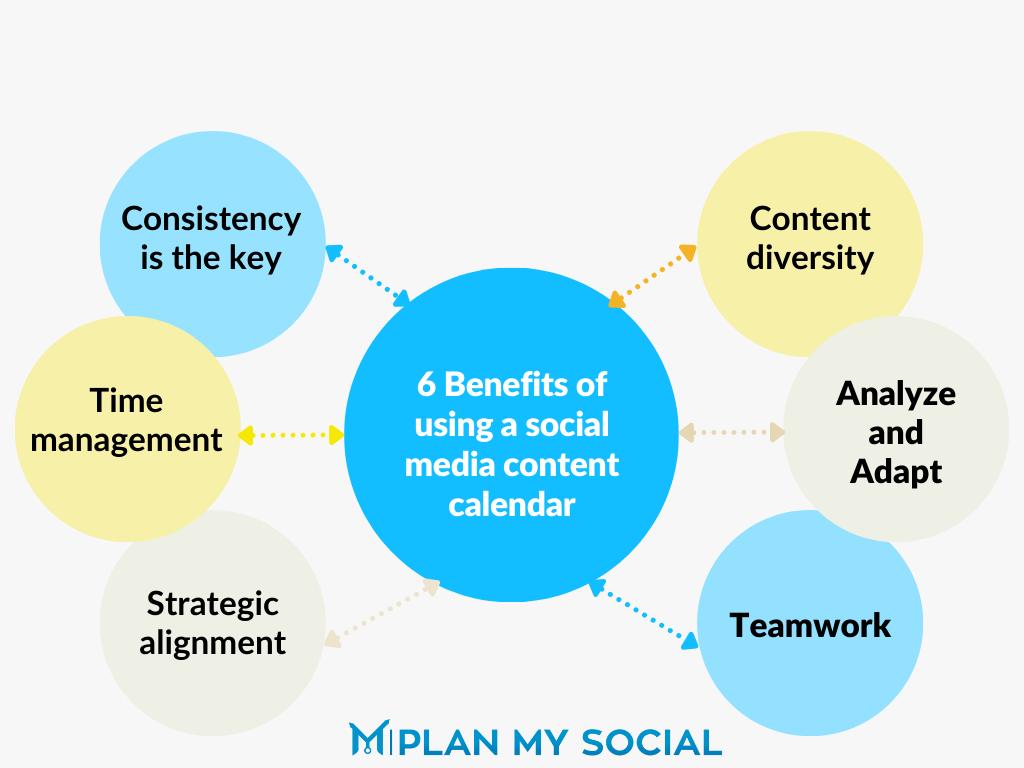
6 Benefits of using a social media content calendar

Benefits of Social Media Content Calendar – Step by Step plan my social

A social media content calendar is a roadmap for your online presence. It helps you organize your content ideas, schedule posts in advance, and ensure consistency across all platforms. Here’s how a well-crafted content calendar can boost your brand:


Consistency is the key

A calendar ensures regular posting, keeping your brand at the forefront of your audience’s mind. This consistency builds brand recognition and fosters trust with your followers. 


Time management

Planning your content in advance is a massive time saver. No more scrambling at the last moment to create posts that could reflect your brand’s identity. You can create content in batches, allowing you to focus on quality over quantity and ensuring a smoother workflow.


Strategic alignment 

Social media content calendar lets you align your social media efforts with other marketing campaigns and your overall business goals. This ensures your messaging is cohesive and delivers a unified brand voice across all platforms.


Content diversity 

Planning allows you to strategically incorporate a mix of content formats – images, videos, infographics, and text. This keeps your audience engaged and interested, preventing them from getting bored with repetitive content.


Analyze and adapt 

Track your content performance using the calendar to see what resonates with your audience. This valuable data allows you to refine your strategy and create even more impactful content in the future.


Teamwork

A content calendar fosters collaboration between marketing teams. Everyone can see the upcoming schedule, ensuring a smooth and streamlined social media workflow.

Create a Social Media Content Calendar - Step-by-Step

You’re prepared to begin now. However, what is the real process for creating your calendar? We advise utilizing our free social media content calendar to get started with a job management tool like Plan My Social.


It allows you to keep track of procedures, report on previous publishing schedules and post cadence, give visibility and collaborate with your team.


However, you can start creating your social media calendar anywhere by using these steps:


Step 1: Audit your social media networks and content

You must perform a social media audit of previous material to assess your current online presence before developing your social media content calendar.

Here’s what to consider:

  • Identify Your Existing Accounts: List all the social media platforms your brand is active on (e.g.,             Facebook, Instagram, Twitter).
  • Analyze Performance: Review past posts and track key metrics like engagement (likes, comments,         shares), reach (number of people who saw your content), and follower growth. Tools like Facebook         Insights or Twitter Analytics can be helpful.
  • Content Audit: Evaluate the types of content you’ve been posting (images, videos, text) and see                what resonates most with your audience.


Throughout your audit, keep the following in mind:


  • Key performance indicators (KPIs) and significant metrics for every account by platform are used to        define success.
  • The objectives of your brand for every account by platform
  • Who your intended audience is
  • Posts and campaigns that perform best and worst
  • Possibilities for advancement or experimentation
  • Regular publication

Step 2: Define your goals and audience

Having clear goals is the foundation for a successful content strategy. Here’s a deeper dive into defining your social media goals and understanding your target audience:

A. Setting SMART Social Media Goals:

SMART goals are Specific, Measurable, Achievable, Relevant, and Time-bound. Applying this framework ensures your goals are well-defined, actionable, and aligned with your business objectives. 

Examples of SMART social media goals:


  • Brand Awareness: Increase brand mentions by 20% within the next quarter.
  • Engagement: Achieve a 5% average engagement rate (likes, comments, shares) on all posts by the          end of the year.
  • Website Traffic: Drive 1,000 new visitors to your website from social media referrals per month.
  • Lead Generation: Generate 50 qualified leads through social media campaigns in the next quarter.

B. Buyer Personas: Know Your Ideal Customer

Learning about your target audience is important for crafting content that resonates. Develop buyer personas to visualize your ideal customer. These personas should encompass demographics, interests, online behavior, and pain points. 

Questions to guide your persona creation:

  • Demographics: Age, gender, location, income level, occupation.
  • Interests: Hobbies, passions, preferred content formats (videos, articles, infographics).
  • Online Customer Behavior: Which social media platforms do they use most frequently? What kind            of content do they engage with online?
  • Pain Points: What challenges or problems does your product or service solve for them?


C. Audience Research Techniques:

There are several ways to gather valuable audience insights:

  • Social Media Analytics: Utilize built-in analytics tools offered by social media platforms like                      Plan My Social to understand your current audience demographics and interests. Tools like                      Facebook Audience Insights or Twitter Analytics provide valuable data.
  • Surveys & Polls: Conduct surveys or polls on your social media channels or website to gather direct        feedback from your audience. Ask questions about their preferences, challenges, and content                   interests.
  • Market Research: Explore existing market research reports related to your industry to gain insights          into your target audience’s behavior and trends.
  • Competitor Analysis: Research competitors’ social media presence. Analyze their content themes,          posting frequency, and audience engagement to identify potential gaps you can fill with your own            unique approach

Step 3: Choose Your Social Media Management Tools

Several social media management tools can streamline your workflow and save you precious time. These platforms allow you to:


Schedule Posts: Plan, generate and schedule posts in advance for all your social media accounts, ensuring a consistent presence.


Create Content:  Social media management tools can help you create posts with the help of AI using your brand theme. 


Analytics Tracking: Track key metrics and analyze post performance across platforms. Gain valuable insights into what’s working and what needs improvement.


Plan My Social is a social media management tool that helps you plan, generate, schedule, and track posts from a single dashboard. Their powerful and seamless integration with Shopify can help you automate your social media platforms by creating content calendars with the help of AI. 

Start your free trial today 

Step 4: Content Planning and Brainstorming

Now comes the fun part of brainstorming content ideas! Here are some strategies to get you started:

  • Content Pillars:

Identify core themes or topics relevant to your brand and audience. Examples could be industry trends, product tutorials, or behind-the-scenes glimpses into your company culture. Content pillars provide a foundation for your content strategy and ensure consistency.

  • Seasonal & Event Marketing

Plan content around upcoming holidays, national awareness days, or industry events relevant to your brand. This is a great way to tap into existing trends and conversations happening online.

  • Curated Content 

Share valuable content from other sources, showcasing your expertise and industry awareness. Be sure to properly credit the original source and choose content that complements your own brand messaging.

  • User-Generated Content: 

Encourage user engagement by reposting content your audience creates (with permission). This is a best way to build brand loyalty and authenticity.

Step 5: Creating your social media content calendar template

The beauty of a social media content calendar lies in its customizability. There’s no one-size-fits-all approach. Here’s are the key elements to consider when building your flexible content calendar template:

  • Platform specificity:

Dedicate sections for each social media platform you’re active on (e.g., Facebook, Instagram, Twitter). Remember, content needs to be tailored to the unique characteristics of each platform.


Example

Facebook: Longer-form content with engaging visuals and links to drive website traffic can perform well.

Instagram: Eye-catching visuals and concise captions with relevant hashtags are essential. Leverage Instagram Stories for behind-the-scenes glimpses or quick announcements.

X (Twitter): Keep it short and sweet! Timely content, trending topics, and engaging questions can spark conversation on Twitter.

  • Scheduling & Posting Frequency:

Plan posting times strategically based on your audience’s activity. Many social media management tools offer suggestions on optimal posting times. Maintain a consistent posting frequency to stay top-of-mind with your audience. However, avoid oversaturation. Aim for quality over quantity.

  • Content Mix: 

Incorporate a variety of content formats to keep your audience engaged. Here are some ideas:
Images: High-quality, visually appealing images are a must across most platforms.

Videos: Short-form video content is highly engaging. Consider bite-sized tutorials, product demonstrations, or customer testimonials.

Text-based Posts: Share insightful industry news and thought leadership pieces, or ask questions to spark conversation.

Live Streams: Offer live Q&A sessions, product demos, or behind-the-scenes glimpses to connect with your audience in real time.

User-Generated Content: Repost content created by your audience (with permission) to foster brand loyalty and authenticity.

  • Content Details: 

Include specific details about each post:

Caption: Craft compelling captions that grab attention and encourage engagement. Tailor the length and tone of each platform.

Hashtags: Integrate relevant hashtags to increase discoverability. Research targeted hashtags specific to your niche and avoid generic overuse.

Visual Notes: Outline any visual elements needed, like image descriptions or reminders to source stock photos or create graphics.


Tip: Use color coding or symbols within your calendar to represent different content types or campaign categories visually. This can enhance organization and provide a quick visual overview of your content plan.

Step 6: Content Creation & Scheduling

Once your calendar is populated with ideas, creating the content is time. Here are some tips for efficiency:

  • Batch Content Creation: Schedule dedicated time to create content in batches, especially for                   visuals like images or videos. This will save time and allow you to stay ahead of schedule.
  • Utilize Design Tools: Many user-friendly graphic design tools, like Canva or Adobe Spark, are                     available that can help you create professional-looking visuals without needing extensive design             expertise.
  • Schedule Posts in Advance: Take advantage of scheduling features of  your social media                         management tool like Plan My Social. It allows you to post consistently without manually                           intervention.

Step 7: Analyze & Adapt

Social media is a dynamic landscape. Don’t be afraid to experiment and adapt your strategy based on results. Here’s how to measure success and refine your approach:


Track Key Metrics: Monitor key metrics like engagement, reach, follower growth, and website traffic. Many social media platforms and management tools offer built-in analytics dashboards.


Analyze Performance: Identify content that resonates with your audience and analyze what factors contribute to its success (e.g., post format, time of day, specific hashtags).


Refine Your Strategy: Use data insights to refine your content calendar and tailor your approach to maximize reach and engagement.

Top Social media content calendar apps

While many sophisticated social media management tools are available, sometimes a simple and free solution is all you need to get started. Here’s a closer look at three free options for building your social media content calendar:

Google Calendar:

A familiar friend for many, Google Calendar can be a surprisingly effective tool for basic social media content planning. Schedule your posts, share your calendar with team members for collaborative brainstorming, and access it from any device for on-the-go management.

Google Sheets

Unleash your inner spreadsheet whiz with Google Sheets. Create a custom content calendar template with specific details for each post, collaborate with your team, and even leverage basic data analysis features to track rudimentary post performance metrics.

Plan My Social

Plan My Social offers a free plan with features specifically designed to streamline your social media content management. Here’s how it can benefit your social media efforts:

  • Effortless Scheduling: Free yourself from the burden of manual posting. Schedule your social                 media content in advance for various platforms, ensuring a consistent presence and saving you                valuable time.
  • Multi-Platform Management: Juggling multiple social media accounts can be overwhelming.                    Plan My Social’s free plan allows you to manage content for different platforms within a single                  interface, simplifying your workflow.
  • Visual Clarity: Ditch the spreadsheets! Plan My Social boasts a user-friendly, visually appealing                interface. Get a clear overview of your content plan, see upcoming posts at a glance, and ensure a          cohesive strategy across all platforms.

While the free plan offers a solid foundation, keep in mind that Plan My Social also has paid tiers with additional features. These might be worth considering as your social media needs grow, offering functionalities like:


  • Advanced Analytics: Dive deeper into post performance with analytics tools that go beyond basic           metrics. Track engagement, reach, and other key indicators to refine your strategy for maximum               impact.


  • Increased Management: Manage more social media accounts as your brand grows, allowing you to        streamline content creation and scheduling for a wider audience.


  • AI Assistance: Generate content with the help of AI and create a calendar by selecting the number           of posts you wish to post each day and for how many days.

Conclusion

Crafting a social media content calendar empowers you to take control of your brand’s online presence. By establishing goals, understanding your audience, and planning engaging content, you can build a loyal following, drive brand awareness, and ultimately achieve your social media objectives.


Remember, consistency is key. Use the free content calendar solutions mentioned above, or explore advanced social media management tools as your needs evolve. With a strategic approach and a commitment to creating high-quality content, your social media calendar will become the roadmap to propelling your brand to new heights.


So, what are you waiting for? 


Start planning, get scheduling, and watch your social media success unfold.

Frequently Asked Questions

Absolutely! Planning allows you to create high-quality, consistent content that resonates with your audience. This fosters engagement and builds stronger relationships.

The ideal schedule depends on your audience and platform. However, aiming for consistent posting throughout the week, with peak times for your audience, is a good starting point.

A social media content calendar should include details like platform, date & time, content type (image, video, text), caption drafts, hashtags, and visuals notes.

Focus on visually appealing content and plan captions with relevant hashtags. Schedule a mix of formats like photos, videos, and Stories to keep your audience engaged.

Define your goals, understand your audience, brainstorm content ideas, choose a scheduling tool, and build your calendar with a mix of formats and posting times.

A monthly social media calendar provides a high-level overview of your content plan for the month, outlining key themes, posting dates, and content types.

Table of Contents

The post How to Create A Social Media Content Calendar – Step by Step  first appeared on Plan My Social.

]]>
Celebrate Every Win with Our super effective Social Media Management Tool https://blog.planmysocial.ai/celebrate-every-win-with-super-effective-social-media-management-tool/?utm_source=rss&utm_medium=rss&utm_campaign=celebrate-every-win-with-super-effective-social-media-management-tool Fri, 19 Apr 2024 11:34:30 +0000 https://blog.planmysocial.ai/?p=10650 You focus on your important tasks, while we automate all your social media posts. Yes, you have heard us right. Manage your social media marketing using this amazing platform. Make the most of the marvels of our social media management tools. How does it turn out to be of great use to many businesses? Ready …

The post Celebrate Every Win with Our super effective Social Media Management Tool first appeared on Plan My Social.

]]>
Social Media Marketing

You focus on your important tasks, while we automate all your social media posts. Yes, you have heard us right. Manage your social media marketing using this amazing platform. Make the most of the marvels of our social media management tools.

How does it turn out to be of great use to many businesses? Ready to dive in?

AI catches every action your users make across your social media accounts

  • Figures out your user preferences. Ensure you implement all real-time suggestions during content           creation. It makes website visits, relevant searches and comparisons and offers you the best                    possible recommendations. It overall recommends when, how and in what manner to post.
  • Survey Questions: Real-Time Feedback throughout content development: How do you find my                  content? Well, it is good but could be better.
  • Could you tell me why you don’t find it so engaging? You have articulated content and yet have                  missed basic user requirements like empathy and some interesting real-life examples. So, AI helps           you realise your areas of strength and improvement.
  • Is there something we don’t offer, but our competitors do? Yes, if we compare your content with that        of your competitors, you need to ensure your content is empathetic, visually appealing (high-                    resolution images or videos) and contains more high search-volume keywords or appropriate                    hashtags.
  • Overall, AI observes users’ actions, examines user search history and historical data and carries out        market research. In simple words, it fills all the gaps so you can outperform your competitors.

Shopify Social Media Integration

With AI, your website visitors can never leave your website dissatisfied. It not only engages your users but also keeps them retained by keeping an eye on their actions. For example, AI notices some users find a profound interest in motivational and time-saving books. Their frequently repetitive actions make things obvious for the latest technology and so for you as a writer. You can recreate marketing strategies by personalising content. Additionally, you can form a niche cum focus group dedicated to people who love reading encouraging and short books. Later, you can conduct one-on-one interviews to know them deeper or make findings. For instance, how satisfied are you with your last purchase? Does poetry interest you? A customer replied, yes, it does interest me to some extent. You discover the fact that poetry can keep this user sustained too. Is there anything we don’t offer? Yes, books on rent, a user replied. Either discover some facts yourself or hand over the responsibility to AI so you can concentrate on tasks that require a great deal of efficiency. Let AI go out of its way to have customer insights, and you, on the other hand, raise your chances of a high promotion soon.

Automate Social Media Posts

you can schedule daily, weekly or monthly posts as you want. We have AI to remind you of all your last day’s customizations. Social media auto-posting saves valuable time or promotes time management. Whether you employ 2, 4 or 8 social media accounts for social media content promotion, our all-in-one app handles it all for you. No point in making switches or dealing with frustrating high page loading time henceforth. Say bye to annoying interruptions with our constructive social media auto posting feature.

Website Performance: for example, AI does data analyses and informs you. You must add a few new product features to drive much attention. You are the CEO of Quillbot and your competitor is ChatGPT. Why are you losing customers? So, AI highlights the differences so you can introduce them soon to raise website traffic. Differences like: have they added new tools or mentioned any other information related to offers, plans, discounts, etc. that you find different or unique?

Frequently Asked Questions

Well, it benefits users in many ways as follows:

·   Promotes time management by posting social media posts automatically 

·  AI as a suggestor suggests what all your content lacks and makes it good enough to receive many likes,                 shares and comments. If most viewers find your content great, they may provide backlinks to your site so               Google can provide optimal results for a user query. You can determine your areas of strength and                           improvement with this highly effective technology.

With our excellent plan my social have different social media marketing tools, you don’t have to worry about the following processes:

·  Content creation process- provides real-time suggestions that are better suited for your target audience.

·  Social Media posting process- decide whether you want to promote daily, weekly or monthly. Provide all the           steps so we can manage the social media content posting part. AI reminds you on your following visit when         you leave the site with incomplete information related to social media posting.

Yes, it really helps you identify the true needs and preferences of your customers by 

  • Conducting daily observations
  • You make discoveries
  • AI searches for the missing features and main points that your competitors are offering. On the whole, AI             ensures every time your buyers or any visitor visit your online store, they have a better experience than the             last.


Table of Contents

The post Celebrate Every Win with Our super effective Social Media Management Tool first appeared on Plan My Social.

]]>
Unlocking Success With A Social Media Management Tool https://blog.planmysocial.ai/unlocking-success-with-a-social-media-management-tool/?utm_source=rss&utm_medium=rss&utm_campaign=unlocking-success-with-a-social-media-management-tool Fri, 19 Apr 2024 10:09:14 +0000 https://blog.planmysocial.ai/?p=10626 Whether it is marketing, enhancing online presence, or building solid brands, all can be done using social media platforms. But this requires a lot more effort. However, with the right social media management tool in hand, businesses can grow faster and engage customers while remaining within their budget. These tools help you monitor, analyze, schedule, …

The post Unlocking Success With A Social Media Management Tool first appeared on Plan My Social.

]]>
Social Media Marketing

Whether it is marketing, enhancing online presence, or building solid brands, all can be done using social media platforms. But this requires a lot more effort. However, with the right social media management tool in hand, businesses can grow faster and engage customers while remaining within their budget.

These tools help you monitor, analyze, schedule, publish, and manage communication with a virtual audience. In this post, you will learn about the countless benefits these management softwares brings, how you can choose one and some of the best social media management software in the market. So, let’s begin. 

Overview of Social Media Management Tools

Social media marketing is all about managing and creating timely, brand-aligned content. This can be a demanding and time-consuming task. A social media management tool streamlines the process of managing different tasks, and that’s even within the time frame. With the innovative features of these tools, you can easily schedule and automate posts, monitor social media conversations, ensure brand consistency, and create structured frameworks. It’s like an all-in-one solution for building connections and elevating brands in the dynamic world of social media. 

Benefits Of Social Media Management Software

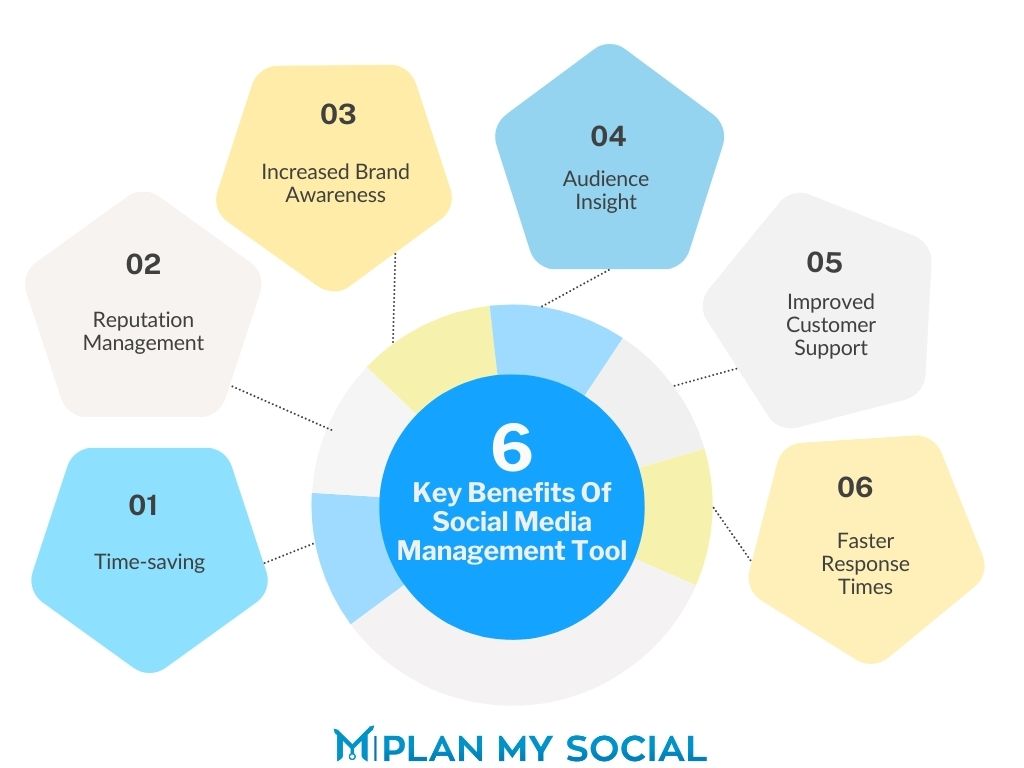
Benefits of Social Media Management Tools - Plan My Social

Whether your business is small or large, social media management software offers great benefits like planning, scheduling, monitoring, and analyzing marketing strategies most effectively. Now, let’s have a closer look at other benefits the tool has to offer you.

Time-saving 

You can keep up a constant online presence by planning on all of your social media platforms. Using a social media management tool, your team may operate more efficiently by batch scheduling articles at the most reasonable time rather than rushing to upload content during the peak hours of the day.

Reputation Management

Social listening features inside your social media management tool enable your business to respond fast to nasty customer comments, fixing problems before the news spreads out.

Increased Brand Awareness

A social media management tool can broadcast your content simultaneously across numerous platforms and at peak publication periods. There is a noticeable rise in the likelihood that your target audience will find you. This significantly increases your chance of getting discovered by your target audience. 

Audience Insight 

By focusing on analytics, the social media management tool can offer you better insight into your audience. Social media analytics lets you know who is following you across all social networks, their geographic location, and other relevant demographic data. Using this data throughout your marketing plan allows you to make more informed marketing decisions.

Improved Customer Support 

Monitoring and responding to customer and prospect queries helps simplify the purchasing process. This also leads to improved customer satisfaction. According to a study published, customers who receive answers to their queries on social media are more likely to remain customers and spend about 49% more money on the brand. 

Faster Response Times

Replying to the customer’s comments on social media is important, but reacting quickly is even more important. The average customer expects businesses to respond to their comments on social media within an hour. Meeting this expectation can be difficult when your business is juggling multiple social media platforms. A social media management tool can simplify this process and make it easy to view comments and mentions across all your networks from one place.

How you can choose the best social media management tool for your business

choose the best social media management tool for your business - plan my social

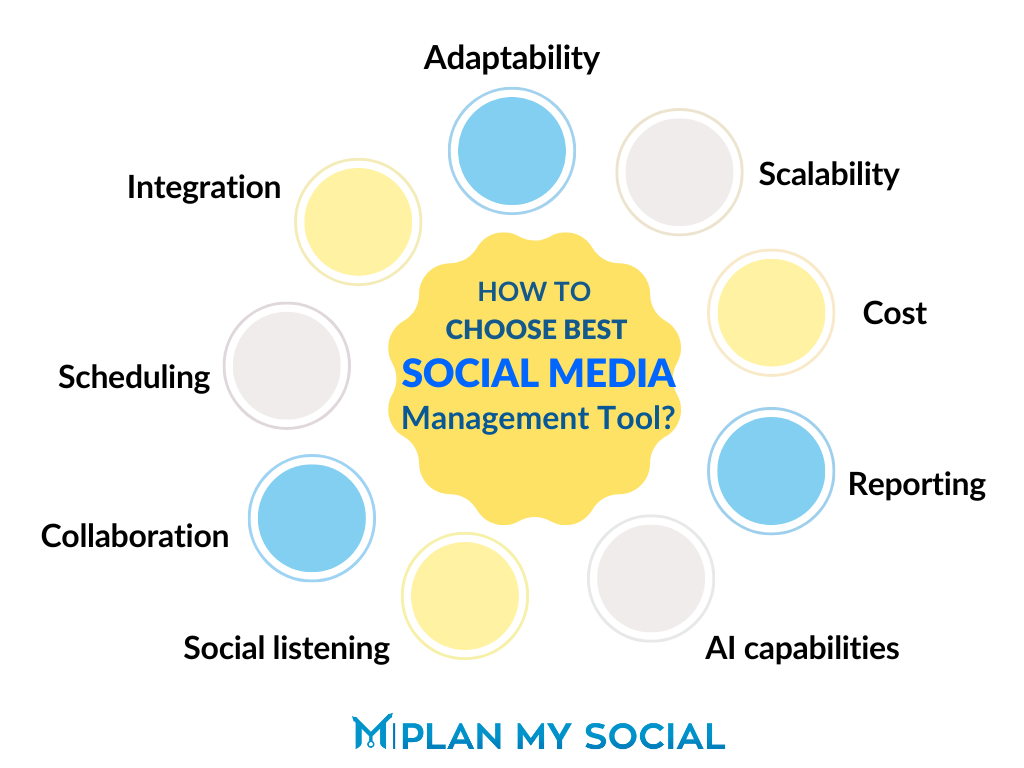
If you are ready to invest in any, there are certain considerations you should care about. Start by going through these essential steps. The following are some important strategies to consider while implementing social media management software for your teams.

Integration

Integration – the most important feature to consider and should be your first priority. Check whether the tool is capable of integrating various social media platforms you use. It is essential to have a comprehensive management system that allows the management of multiple social accounts, all from a single location. 

Scheduling

One of the most important parts of managing social media is publishing. Thus, you need a tool to make the process easier. Choose one with features like planning social media postings and recommending the ideal times to publish. If you need to prepare hundreds of articles each month, having bulk scheduling features is a necessity.

Collaboration

You require a solution that facilitates easy cooperation, whether you operate with clients or a small team. Seek for one with message approval protocols, multi-user features, and a shared publication schedule.

Social listening

The ability to monitor and interact with meaningful conversions is a fundamental component of social media management. Therefore, in order to keep an eye on mentions of your brand as well as certain keywords and tags, you need a platform that can do social listening.

AI capabilities

Having AI marketing skills gives you an advantage, but it’s not required. AI-powered features are available in social media applications, particularly in content creation. You’ll be able to create fresh social media posts more quickly if you can quickly come up with concepts and captions.

Reporting

To choose the best social media management tool, make sure it’s simple to display your KPIs and how well you’re performing. It is important to conduct thorough social media research to create client reports and impress stakeholders with your data. 


Reporting is critical for identifying what works and what does not in your social media strategy. So, make sure the tool can track all of the social media activities that are important to your organization.

Cost

Selecting the finest social media management software requires figuring out crucial features you need and determining whether they fit your business size and scope. Free software serves as a great option for startups and solo marketers, but remember that their limitations can justify the price tags. When investing in such a tool, be sure of your total cost of social media marketing. 

Adaptability

How well the tool adapts to changes in your social media strategy is another important factor to consider. Ask yourself some questions: Is there a built-in editor if you want to add more images to your content? Can you get hashtag ideas on whether you’re going to use more hashtags? Make sure it has every function you wish so that it can easily adjust to your most recent social media strategy.

Scalability

Another key element is the capacity to scale in response to your changing demands. Much like the previous element, scalability helps ensure that your tool can support business development or expansion. Additionally, it should be able to add new users and social accounts.


With a little research, the perfect social media management platform may help your company expand and reach new consumers. 

Some of the best social media management tools examples

Some of the best social management tools examples include Plan My Social, Hootsuite, Buffer, Zoho Social, and Sprout Special. Below is the detailed overview about these tools:

 HootsuiteBufferZoho SocialSprout SpecialPlan My Social

Starting prices

$99 per monthFree; $5 per month$10 per month$249 per month$5.99 per month

Free Trail

30 days (required credit card)15 days (credit card not required)14 days

30 days (credit card not required)

–
Social NetworksInstagram, Facebook, LinkedIn, Twitter, TikTok, Twitter and YouTubeLinkedIn, Twitter, Instagram, Facebook, TikTok, YouTube, Pinterest, Google Business Profile and MastodonInstagram, Facebook, LinkedIn, Twitter, TikTok, YouTube, Pinterest and Google Business ProfileWhatsApp, Facebook, Twitter, TikTok, LinkedIn, YouTube, Instagram and PinterestShopify, Facebook, Instagram, Pinterest, LinkedIn, Tik Tok, Twitter (soon) and YouTube (soon)
Unlimited PostsYesYes, with all paid plansYesYesYes

Draft, Schedule and Publish Posts

YesYesYesYesYes (Weekly/ Month)
Post Time OptimizationYesYesYesYes, with the Professional plan ($399 per month)Yes

Reports and Analytics

YesYesYesYesYes

Canva Integration

YesYesYesYesNo
Grammarly IntegrationYesNoYesYesNo
Customer Support

Live chat and also 24/7 support via Twitter and Facebook

Via email only24/5 support via email

24/5 via live chat, tickets and phone

24/7 via email, WhatsApp, phone(only for pro/premium users)
Learn moreHootsuiteBufferZoho SocialSprout SpecialPlan My Social


Let’s explore more about Plan My Social. From the above table, we have seen various features of Plan My Social but there are other amazing features they provide to users. The features includes: 

  • Competitor Analysis
  • Analytics
  • Hashtag Suggestion
  • Email Support
  • Phone Support (Pro/Premium)
  • Store Branding
  • Image Editor
  • Video Editor (Coming Soon)
  • AI Generated posts
  • AI Generated captions
  • Social suggestions (Pro/Premium) 

Users can access all features mentioned above no matter which plan they have subscribed to. But there are some limitations in the Basic plan. Only users with Pro and Premium subscription can get Phone Support and Social Suggestions features. 


Plan My Social offers three different types of plan:

PlanPriceAccounts
Basic $ 5.99 per month 3
Pro$ 9.99 per month6
Premium$ 19.99 per month10

All the plans of Plan My Social are affordable and don’t make a hole in the customer’s pockets. 

Conclusion 

Congrats! You have learned the process of selecting the most convenient social media management tool, and the benefits it offers. Also, we have come across some social media management tools examples that include innovative tools that help you fulfill your business goals. 


Follow the above steps and have one to boost your business and stay ahead of your competition. 

Frequently Asked Questions

A social media management tool is a software solution that allows you to manage all of your social media accounts in one place. This means you can carry out several social media tasks without switching to a separate platform.

Social media management software enables marketers and businesses to plan, develop, and publish social media postings. In this way, marketers can track interaction, evaluate performance, and make their brand soar across multiple social platforms. 

These are some points you need to remember when buying any social media management tool:

  • Examine the size of your organization. 
  • Check out the available funds. 
  • Look out for core features. 
  • Check whether it integrates quickly with the application. 
  • Have a User-friendly interface. 

Social media management tools allow marketing managers, small business owners, and content writers to save time by scheduling social media postings across several accounts. Whether it’s reviewing top-level statistics or generating real leads, these tools allow users to complete any tasks ahead of time. 

Community management is the use of social media to create an active online community that fosters brand loyalty. Managing an online community involves:

  • Constantly monitoring social media platforms
  • Engaging with consumers, prospects, and influencers
  • Gathering feedback

Table of Contents

The post Unlocking Success With A Social Media Management Tool first appeared on Plan My Social.

]]>